Industrial Automation Services - Quick Summary

MicronTech carries out turnkey industrial automation projects. Sectors served: mainly pharmaceutical and biotechnology facilities as well as hospitals, office towers and commercial buildings; also other production plants such as food. Scope of services: PLC programming (Siemens, Schneider, Omron, Beckhoff), SCADA development (WinCC, Wonderware, Ignition), EMS installation, validation documentation following the GAMP 5 guideline, instrumentation (Endress+Hauser, Wika, Setra), BMS/HVAC automation, renewal of existing machines (retrofit). Core expertise: particle monitoring with Particle Measuring Systems (PMS) instruments, record-keeping systems configured to support 21 CFR Part 11 requirements, DQ/IQ/OQ/PQ qualification documentation. Contact: +90 850 346 99 17.

Solution Areas
BRANDS WE WORK WITH
Siemens Schneider Rotronic Particle Measuring Systems Setra Dwyer Endress+Hauser Belimo Beckhoff Samson
Technical Support

If your existing system has a fault, contact our service team.

Request Service

Measurement and Control from Field to Report

MicronTech is an engineering company that installs measurement and control systems, from sensors and actuators in the field up to monitoring and reporting software, in strictly inspected industries, above all pharmaceuticals and biotechnology, as well as in commercial buildings.

Alongside the PLC software, we use calibration to check that critical parameters such as temperature, humidity, pressure, flow, level and particles are measured correctly and, where required, we prepare the validation documentation and run the tests against the requirements of GMP and the relevant ISO standards.

Pharmaceuticals, Biotechnology and Cleanrooms

EMS (Environmental Monitoring System)

Continuous monitoring and recording of critical cleanroom parameters. Depending on the software used and the validation scope, the record-keeping is configured to support 21 CFR Part 11 requirements.

  • Particle Monitoring: particle counting in the 0.3–5.0 µm range with Particle Measuring Systems (PMS) instruments.
  • Temperature & Humidity: Precise mapping with Rotronic/Vaisala sensors.
  • Differential Pressure: Room pressure differential control with Setra/Dwyer transmitters.
  • Alarm Management: Signal towers, sirens, SMS and e-mail notifications.
Cleanroom

Field Instrumentation and Sales

Process control depends on accurate measurement. We select field instruments from the brands below to suit each project, supply them and commission them.

Flow & Level
  • • Electromagnetic Flowmeters
  • • Ultrasonic & Radar Level
  • • Mass Flow Meters (Coriolis)
  • • Brands: E+H, Krohne, Siemens
Temperature & Pressure
  • • PT100 / Thermocouple Sensors
  • • Pressure Transmitters
  • • Differential Pressure Switches (DPS)
  • • Brands: Wika, Danfoss, Dwyer
Analytical Measurement
  • • pH / Conductivity
  • • Dissolved Oxygen
  • • TOC (Total Organic Carbon)
  • • Brands: Mettler Toledo, Hamilton

BMS & HVAC Automation

Building management systems (BMS) for office towers, hospitals and industrial facilities: control of HVAC equipment and monitoring of energy consumption.

  • AHU (Air Handling Unit): Temperature, humidity and pressure control.
  • Chiller & Boiler: Lead/lag run-time equalisation and efficiency optimisation.
  • VAV / Fan Coil: Room-level comfort control.
  • Communication protocols: BACnet, Modbus, KNX, LonWorks.

Process Control & Machine Building

PLC/SCADA software and custom machine building for your production lines.

PLC & SCADA Software
Siemens S7-1500/1200, Schneider M241/251, Omron and Delta PLC programming. Production data reporting and recipe management with WinCC, Wonderware and Ignition SCADA.
Machine Building & Renewal of Existing Systems
Manufacturing of liquid/powder filling machines, labelling and conveyor systems. Renewal of existing older machines (retrofit) through control panel and software revisions.

Validation & Calibration Services

We show with tests and documents that the systems we install work correctly. We prepare the qualification protocols and reports that pharmaceutical and food manufacturers need for inspections, following the customer's validation plan. DQ (Design Qualification) documents that the design meets the user requirements. IQ (Installation Qualification) verifies that the equipment is installed according to the approved design and the manufacturer's specifications. OQ (Operational Qualification) tests that the equipment operates as specified across its defined operating ranges. PQ (Performance Qualification) verifies that the system consistently delivers the expected performance under real production conditions.


DQ (Design Qualification)
IQ (Installation Qualification)
OQ / PQ (Operational and Performance Qualification)
Temperature/Humidity Mapping
Sensor Calibration
Risk Analysis

Production Data Acquisition & Reporting

We turn the data we collect from PLCs and field devices on site into reports that can be used for production and maintenance decisions.

Data Acquisition

Centralised data collection from PLCs, energy analysers and field devices via OPC UA and Modbus TCP/RTU protocols.

Production Monitoring & Reporting

Machine downtime analysis, efficiency (OEE) measurement, shift-based and line-based production reports.

Recipe & Batch Records

Recipe management on SCADA, batch reporting and archiving of production records.

Sectors We Serve

The table shows the two sector groups we work with most, the typical applications in each and the related regulations, guidelines and protocols. Our core areas of expertise (EMS, instrumentation, BMS/HVAC, process control, validation and calibration) are described in the sections above.

Sector Typical Applications Hardware We Use Regulations, Guidelines & Protocols
Pharmaceuticals & Biotechnology EMS (environmental monitoring), particle counting, temperature/humidity mapping, differential pressure control, validation and calibration Siemens S7-1500, PMS particle counters, Rotronic, Setra GMP, 21 CFR Part 11, EU GMP Annex 11 (regulations and guidance); GAMP 5 (ISPE industry guideline)
Hospitals, Office Towers & Commercial Buildings HVAC/air handling unit control, chiller and boiler management, VAV/fan coil, energy consumption monitoring Schneider, Belimo, Siemens, Beckhoff BACnet, Modbus, KNX (communication protocols)

Project Process - Commissioning in 5 Steps

1
Survey & Analysis

Site visit, documentation of the existing system, list of requirements.

2
Engineering

P&ID, I/O list, panel schematics (EPLAN), bill of quantities (BOQ), functional design specification (FDS).

3
Software & FAT

PLC/SCADA software, factory acceptance test (FAT) in our workshop, customer approval.

4
Installation & Commissioning

Panel transport, on-site installation, sensor calibration, site acceptance test (SAT).

5
Training & Maintenance

Operator training, as-built documentation. The maintenance contract and support scope are defined per project.

Frequently Asked Questions About Automation

Industrial automation means running processes in manufacturing and process plants automatically with control systems such as PLCs, SCADA, sensors and actuators. A well-designed system reduces manual work and human error, provides traceability by keeping a record for every batch, makes it easier to track energy consumption and contributes to worker safety by allowing remote intervention in hazardous processes. The actual benefit depends on the current state of the plant and the project scope.

A PLC (Programmable Logic Controller) is a rugged industrial computer that controls field devices (sensors, motors, valves) at millisecond level. SCADA (Supervisory Control and Data Acquisition) is the higher-level software layer that collects data from multiple PLCs, provides the operator with a graphical interface and logs alarms and trends. A simple analogy: if the PLC is an aircraft's autopilot, SCADA is the airport control tower.

GAMP 5 (Good Automated Manufacturing Practice) is an industry guideline published by ISPE for the risk-based validation of computerised systems used in pharmaceutical manufacturing; it is not binding regulation, but a widely used method for demonstrating that requirements are met. 21 CFR Part 11 is the binding US FDA regulation that sets requirements for electronic records and electronic signatures; in the EU the same subject is covered by EU GMP Annex 11. These requirements concern manufacturers whose products go to the US or EU markets or who are inspected by the relevant authorities. If an inspection finds gaps in validation, sanctions such as a warning letter may follow. Meeting Part 11 requirements is not achieved by the product alone; the product's technical features, the user's procedures and the validation work are assessed together.

For machines whose mechanical parts (frame, motor, gearbox) are sound but whose electronics are outdated, renewing the existing system (retrofit) is often less expensive than buying a new machine. The cost difference depends on the machine and the scope of the renewal; both options are assessed together during the site survey. The scope usually covers PLC and HMI replacement, frequency inverters (VFDs) and drives, sensors and new software. If mechanical wear is advanced, spare parts are unavailable or you want to increase production capacity significantly, a new machine may be the better choice.

These three layers are arranged in the ISA-95 model. SCADA (Level 2): supervisory control, i.e. real-time monitoring and control. MES (Level 3): manufacturing execution; shift plans, OEE, quality records, batch reporting. ERP (Level 4): enterprise resource planning; orders, purchasing, finance, inventory. We set up the data connection between SCADA and MES/ERP via OPC UA or REST APIs, to the extent the systems support them.

The duration depends on the number of signals, the current state of the site, the software scope and whether validation is required. Renewing a single machine takes much less time than a plant-wide SCADA and EMS installation that requires GAMP 5 documentation. In projects that require validation, documentation and testing take up a significant part of the schedule. The duration is stated in the project plan prepared after the site survey.
SITE SURVEY REQUEST

Request a Site Survey for Your Automation Project

Our engineers review the existing system and your requirements on site, report their findings and prepare a detailed, itemised quotation. Survey conditions and quotation lead time are stated according to the scope of the work.
Request a Site Survey
+90 850 346 99 17
NEW DISTRIBUTORSHIP

When your SCADA PC fails at night, you can make the first intervention remotely.

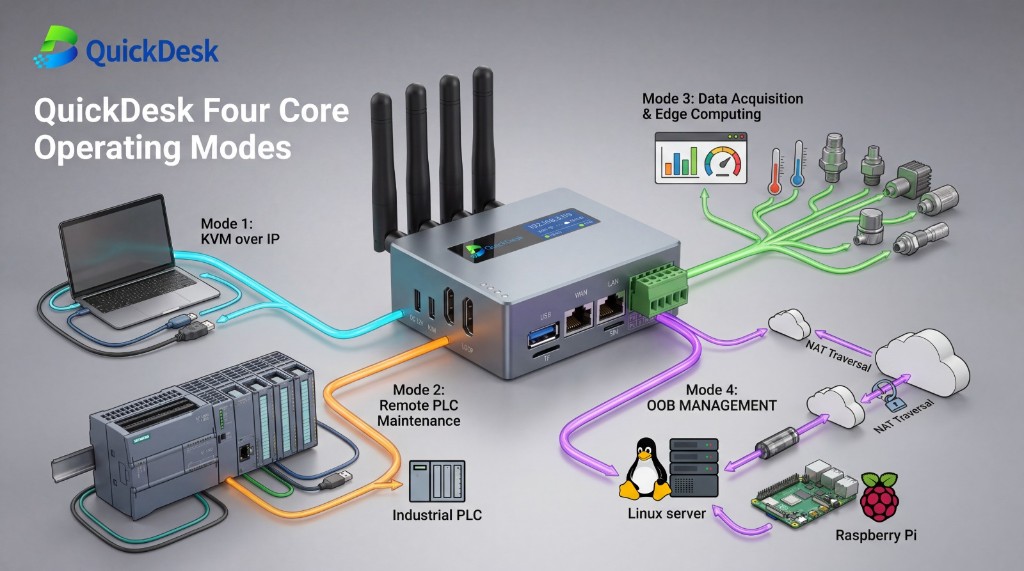
QuickDesk Pro is a hardware-based KVM (screen, keyboard, mouse) device that connects over HDMI and USB to the engineering computer running the PLC programming software, or to the SCADA / HMI computer used by the operator. Access is through a web browser and no software is installed on the target computer; in KVM use the existing connection between the PLC and the computer is kept. In remote PLC maintenance, the PLC can also be connected to the device's LAN port over Ethernet. If the operating system does not start but the computer powers on and outputs video over HDMI, you can reach BIOS/UEFI and recovery menus and intervene; power supply, motherboard or video hardware faults require on-site work. In your Siemens / Schneider / Omron / Beckhoff projects, in KVM use the engineering software and its licence stay on the customer's computer, so no licence transfer is needed.

OS-independent access
4G / Wi-Fi / Ethernet
On-premise server option
CE + RoHS product conformity
Explore QuickDesk Pro Get a Quote
QuickDesk Pro Operating Modes